When you want to enjoy a good sailing trip , it is always important to have some clear concepts about sailing. It is a fact that you are not going to be in charge of the handling of the boat, however, knowing some key aspects will allow you to be much safer and also enjoy the trip more.
Knowing the sailboat you are going to travel on will allow you to orient yourself much better during the first few days and having knowledge of first aid will help you be prepared for an emergency situation. Beyond all these aspects, it is also important to know the environment through which you are going to travel, the sea. That’s why in this article we’re going to focus on one of its most important components, waves.
As we will see later, there are different types of waves. The purpose of this article is for you to learn more about the types of waves that exist and how they are formed in order to understand how traveling by sailboat you can enjoy them much more always in a safe way.
What are waves and how do they form?
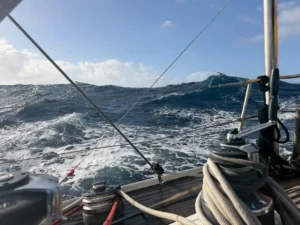
If there is something common in the vast majority of sailing trips, it is the wind and the waves. A wave is a ripple of water that occurs on the surface of the sea, usually due to the action of the wind. Because sailboats, by their very nature, perform best in areas that have a lot of wind, waves are often a feature of sailing trips.
Depending on how hard the wind is blowing or how far it is blowing, waves can be larger or smaller. This small ripple phenomenon can be experienced by yourself if you blow on a water surface.
On the other hand, it is important to note that wind is not the only phenomenon that can cause waves. Geological processes such as earthquakes can generate much larger waves. When an earthquake breaks the sea floor, the sudden change in sea surface level is capable of generating waves hundreds of miles away around that area.
These waves generated by earthquakes can be quite dangerous, becoming real mountains of water that can travel at speeds of up to 700 km/h. Fortunately, these waves tend to be less common, as many of them are related to Tsunamis.
Be that as it may, the phenomenon of waves is very important and there are many scientists who study what waves are like to take advantage of the energy they have and also to make the coasts safer places.
Types of waves: Classification and characteristics
There are a large number of different waves and knowing them is essential to know how they can affect the navigation of a sailboat.
Let’s start with the oscillation waves. These types of waves get their name because the water doesn’t move forward. In these waves, the water only describes a twist as it rises and falls practically in the same place where the wave began. These waves are the most common and are also perfect for surfing.
Another type of wave is translational waves. These types of waves are those that occur close to the coast. The translational waves touch the bottom, advance and crash against the coastline forming a large amount of foam. When these waves return into the seawater, the effect that is commonly known as a surf occurs.
These waves are more difficult to see with the naked eye, as the movement of the wave does not take place on the surface of the sea, but takes place in a deeper part of the sea. This type of wave is oscillating, that is, it moves in circles a little below its surface, so its movement is hardly noticeable.
On the other hand, we have seismic waves. As you can tell from their name, these waves are those that occur due to earthquakes in the oceanic crust. They are the most dangerous waves when they reach the coast. They are also commonly referred to as tsunamis.
These seismic waves are quite frequent when there are earthquakes or volcanic eruptions. Due to the shaking of the earth, several seismic waves can occur in a chain that, although they are one of the least common types of waves, when they occur they can be a threat to the coast.
Tidal waves are those that are formed by the gravitational attraction between the moon and the sun on the earth. Because the moon and sun draw water from the earth toward them, a lump is created on the surface of the water. This is the way in which the stars influence the tides and also the creation of these tidal waves.
Finally, other of the most common are wind waves. There is little more to add about these types of waves, they are those that form when the wind exerts force on water molecules causing them to move. As these molecules accumulate, the wave is created.
Parts of a Wave
Although they may all seem the same, the truth is that the waves have well-differentiated parts. Before we start talking about the parts of the waves, we must keep in mind that these can be grouped into two main categories, the vertical parts and the horizontal parts.
Within the vertical parts of the wave we find the crest, which is the highest part of the wave and which is evidently more prominent when the wave is larger. At the bottom of the wave we find the bottom. The face is the part of the wave that lies between the crest and the bottom, right on the surface. Finally, the lip is the top of the wave, but only at the moment before the wave breaks.
As for the horizontal parts, one of the most significant is the wavelength. By this term we mean the distance between two adjacent ridges. Another part is the period, which is understood as the time it takes for the wave to complete the cycle from one crest to the next. Finally, speed is also taken into account, which is the distance that the wave is able to travel in a given period of time.
In addition to these parts, there are also other important elements of the waves to consider. One of the most visible parts is the wave foam that forms when the wave breaks. There is also a part called a tube, which is the tunnel that forms when the wave breaks and the crest collapses it. Finally, the height. Height is a term that is often confused with ridge, but basically height is the difference between the ridge and the valley.
Wave Height
As mentioned above, height is the difference between the crest and valley of the wave and is measured in feet. The height of the wave is variable and depends on several factors , with the sum of all of these determining the final height of the wave.
One of the factors that most influences the height of waves is the wind. The stronger the wind, the higher the height of the waves. In addition to the wind, another aspect to consider is the wavelength. Waves that have a longer wavelength are waves that carry more energy, and therefore the wave can become taller and stronger.
Another aspect is the depth of the water. As we have seen, not only the height or crest of the wave is taken into account, other aspects that are under the water also influence the creation of the wave itself. This is one of the reasons why waves are higher in deep water compared to shallow water.
Finally, the shape of the shoreline is also an aspect that can influence the height of the wave. This is something that can be observed on coasts with cliffs or reefs, as the waves are higher compared to the waves that reach the softer beaches.
How Wave Height Is Measured
There are several ways to measure wave height, with one of the most common being the wave meter. A wave meter is a device that makes use of an acoustic sensor or laser to measure the height of waves.
Another more conventional way to measure waves is by making use of a photograph or video. The height of a wave can be estimated by taking into account the distance between the crest of the wave and the bottom of the water.
Interestingly, one of the highest waves on record occurred off the coast of Hawaii in 1979, where a wave that reached 38 meters in height was documented. Measuring waves is not carried out on a whim, but is important for activities such as surfing, fishing and, of course, sailing.